


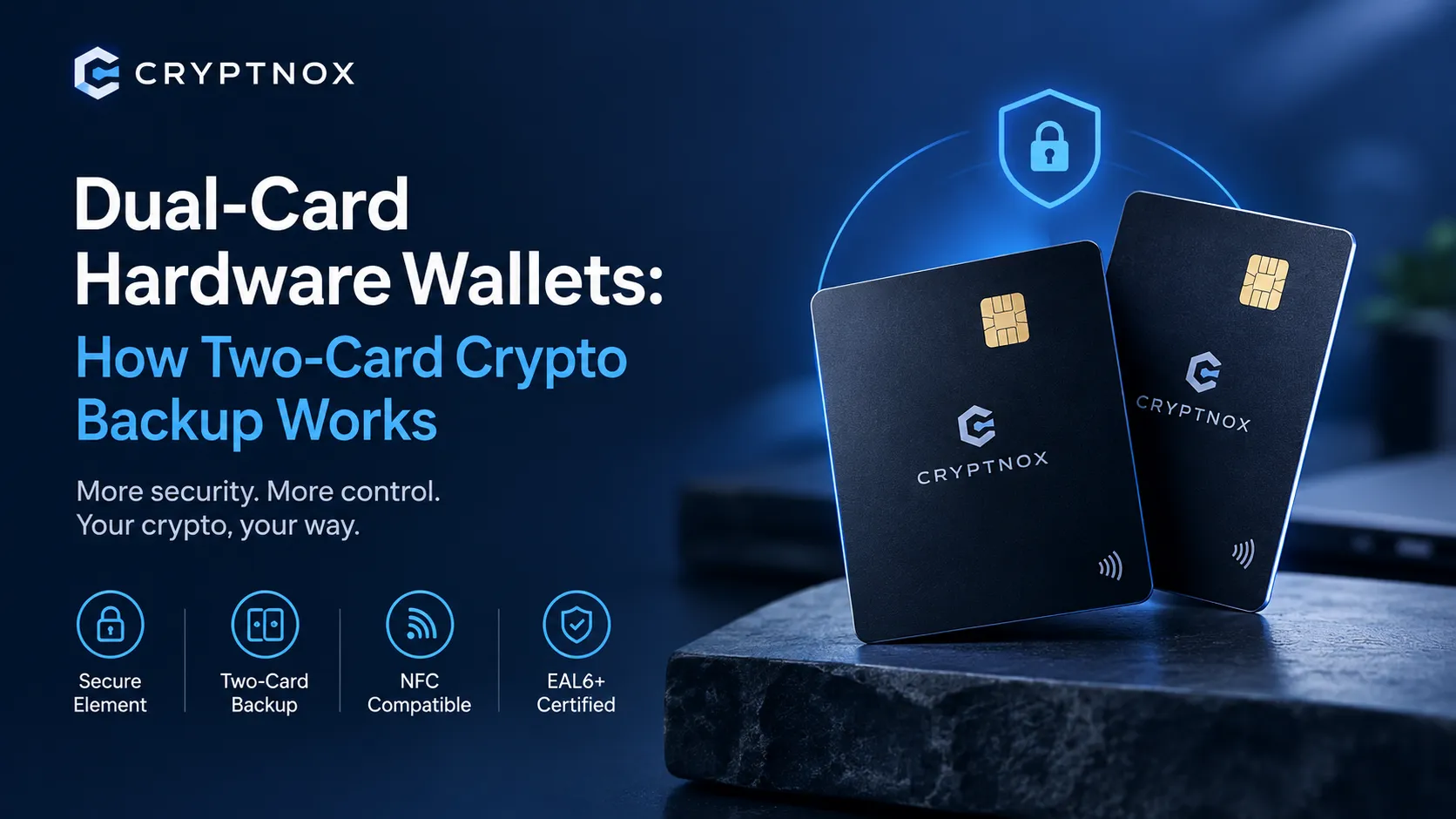
A dual card hardware wallet provides a practical approach to crypto self-custody by placing the same wallet backup on two separate physical smart cards. Instead of relying solely on a written seed phrase, users can keep one card for regular transactions and store the second card securely as a backup. This model is particularly useful for cryptocurrency holders who want offline key storage while reducing the risks associated with losing a single device or mishandling recovery information.
A dual card hardware wallet combines secure-element technology, offline storage, and a physical backup mechanism. Cryptnox uses an EAL6+ certified secure element, with private keys generated and stored on the card. Its Dual Card Set can initialize both cards through a paired process in which the seed is computed inside the secure elements rather than displayed as a 12- or 24-word phrase.
What Is a Dual-Card Hardware Wallet?
A dual card hardware wallet consists of two physical wallet cards configured around the same cryptographic wallet. One card acts as the primary signing device, while the other remains in secure storage as a recovery option.
The concept is straightforward:
- Card 1 is used for everyday crypto transactions.
- Card 2 is stored separately as the backup.
- Both cards can contain the same wallet credentials.
- The private keys remain protected inside secure hardware.
- If the primary card is lost or damaged, the backup card can restore access.
With a traditional hardware wallet, backup often means protecting a recovery seed phrase. A two-card hardware wallet changes that workflow by making the backup physical and immediately available as another secured card.
This approach can be valuable for users managing long-term holdings because the backup can be kept away from the primary wallet, reducing dependence on a single physical device.
How Two-Card Crypto Backup Works
The key difference between a basic duplicate device and a purpose-built dual card hardware wallet is how the backup is created.
With the Cryptnox Dual Card Set, both cards are initially uninitialized. During the paired-card ceremony, the Cryptnox app coordinates a three-step ECDH exchange between the two secure elements. Randomness is generated by the cards’ on-chip true random number generators, and the resulting seed is committed to both cards. The seed is not displayed in plaintext or written down during this process.
In practical terms, the process looks like this:
- Receive the two uninitialized wallet cards.
- Start the setup process in the Cryptnox app.
- Present both cards as instructed.
- The secure elements participate in the paired cryptographic exchange.
- The same wallet seed is committed to both cards.
- Keep one card for everyday signing and store the second securely.
This creates a hardware wallet with backup card functionality without requiring users to manually copy sensitive recovery information.
Why Use a Hardware Wallet With Backup Card?
A major benefit of a hardware wallet with backup card is redundancy.
Consider a user who keeps a single hardware wallet in a home office. If that device is lost, physically damaged, or becomes inaccessible, recovery may depend entirely on a seed phrase. If the phrase was stored incorrectly, recovery becomes much more difficult.
A dual-card hardware wallet provides another physical access point to the same wallet. The primary card can remain with the owner, while the backup card can be stored in a secure location.
This separation is important. The backup should not normally be carried alongside the primary card because losing both together defeats much of the redundancy.
Smart Card Security for Crypto Self-Custody
A smart card wallet backup uses the security architecture of smart-card technology rather than treating the card as ordinary removable storage.
Cryptnox cards use an EAL6+ certified secure element. Private keys are generated and stored within the secure element and are designed not to leave the chip. The card also communicates with the Cryptnox application through an authenticated and encrypted secure-messaging channel during signing.
The card form factor also provides operational advantages. It does not require a battery or charging cable, and transactions can be signed using NFC with a compatible phone.
For organizations and experienced crypto users, this can make a crypto hardware wallet backup solution easier to integrate into physical security procedures. For example, a company could designate one card for controlled operational use and store its paired backup under separate access controls.
Dual-Card Crypto Wallet vs. Seed Phrase Backup
A dual-card crypto wallet does not necessarily eliminate seed phrases in every workflow. Cryptnox also supports importing an existing 12- or 24-word BIP39 seed for users migrating from another wallet or maintaining an off-card backup.
However, its paired initialization provides another model: the wallet seed can be generated and committed to both cards without displaying it to the user.
This distinction matters because seed phrases create their own security responsibilities. Anyone who obtains a valid seed phrase may potentially gain control over the associated assets. Users must therefore protect paper, metal, digital, or other seed backups against theft, unauthorized photography, accidental disclosure, and physical destruction.
A dual card hardware wallet shifts part of that responsibility toward physical card security.
Practical Backup Strategy
Using a dual card hardware wallet effectively still requires good operational security.
A sensible setup is to:
- Use the primary card for routine transactions.
- Store the backup card in a separate secure location.
- Protect PIN and administrative recovery information.
- Avoid exposing both cards unnecessarily.
- Keep the wallet application and compatible devices updated.
- Verify supported blockchain networks before transferring funds.
- Test the recovery procedure with a small amount before relying on it for substantial holdings.
The objective is not simply having two cards. The objective is creating a recovery plan that remains usable while keeping unauthorized access difficult.
Is a Dual-Card Hardware Wallet Right for You?
A dual card hardware wallet can be useful for crypto holders who want physical redundancy without maintaining their entire backup strategy around a written recovery phrase.
It is particularly relevant for long-term holders, frequent travelers, security-conscious individuals, and businesses that need a defined backup procedure. The smart-card form factor can also appeal to users who prefer a wallet that is compact, battery-free, and compatible with NFC-based signing.
As with any self-custody solution, security ultimately depends on how the wallet is initialized, stored, accessed, and recovered.
Conclusion
A dual card hardware wallet provides a different way to approach cryptocurrency backup: instead of depending exclusively on a recovery phrase, users can maintain a primary card and a physically separate backup card containing the same wallet credentials. Cryptnox’s paired initialization is designed so the seed is generated through the secure elements and committed to both cards without being displayed in plaintext.
For users seeking a crypto hardware wallet backup solution, this model combines redundancy with smart-card security and offline key protection. The result is a practical self-custody architecture where losing the primary card does not necessarily mean losing access to the wallet. As always, the backup card, authentication credentials, and physical storage locations should be treated as critical security assets.
